


Since the mid-1960s, lasers have been used for mark-making, etching, and cutting. The world's first laser marking machine was developed in 1965 for the future drilling of holes in diamond manufacturing molds, and the technology subsequently gained rapid momentum.
CO2 lasers for marking occurred in 1967, and the technology reached maturity in the mid-1970s through the commercialization of modern CO2 laser systems. Since then, laser marking systems have become a mainstay in a wide range of industries from aerospace to medical device manufacturing, pharmaceuticals, and retail.
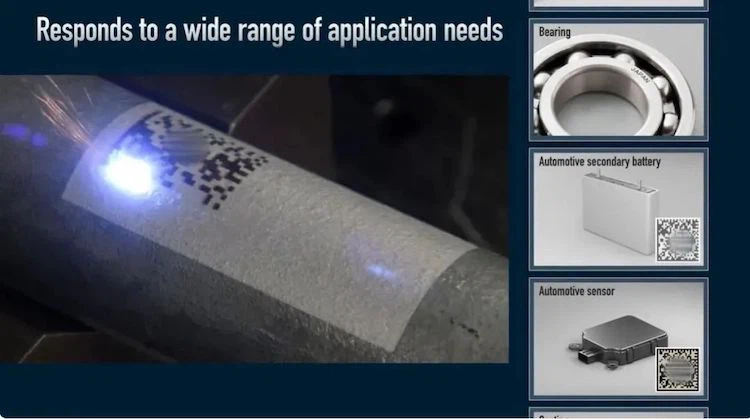
Despite competing with other technologies such as inkjet printing, lasers have been stamped as a powerful, low-cost, and repeatable mark-making technology. Importantly, the process is eco-friendly and requires no consumables (such as ink, cartridges, and paper). Now, laser marking systems no longer rely solely on CO2 lasers; others, such as fiber lasers and Nd: YAG solid-state light sources, offer smaller footprints, lower maintenance costs, and efficient alternatives; and advances in technological capabilities are evident. The fastest commercial laser marking machines can now process tens of thousands of parts per hour.
These challenges come from new materials to be processed, and new applications to be served - each driving the need for growth and innovation while shaping the market for laser system development.
are one of the fastest-growing materials in laser processing, and this material is particularly important in the manufacture of semiconductor parts and circuit boards. Often referred to as the "mother of all electronic system products," printed circuit boards (PCBs) are a component used in virtually all electronic products, and small changes in PCB development have a significant impact on market trends.
In recent years, the focus has shifted to the use of ceramics in conventional printed circuit boards (PCBs), which are made from plastic epoxy resins such as FP4. Ceramic circuit boards offer excellent heat treatability, are easy to implement, and provide superior performance compared to non-ceramic PCBs. However, many marking techniques-such as screen processing are not suitable for ceramics. Ink marking of ceramics is cumbersome, requires several consumables, and is not resistant to abrasion. The brittleness and hardness of ceramics also make them one of the more difficult materials to mark.
As a result, lasers have risen to prominence in recent years as an alternative to ink-printing technology, and many laser companies have developed systems particularly suited to ceramic markings, such as diode-pumped solid-state UV lasers, as well as conventional CO2 lasers.
"This includes a trend towards miniaturization," says Andrew May, director of a laser marking company. However, he emphasizes that introducing new market trends does take time as well, "Is there a new application every week? No. But 15 years ago, we never marked on miniature ceramics, and now we do."
The company has eight laser systems (five of which are Galv-driven) providing marking services for a wide variety of applications. Because of this, and because the company is always acquiring new customers with bespoke requirements - May emphasizes that the ability to be flexible is vital. As a result, it uses lasers suitable for marking different materials, shapes, and sizes, as well as different batch sizes. The range of markers it can offer is also as diverse as its customer base, with its lasers capable of producing everything from codes to graphics and data matrices - all at high speeds and with high reproducibility.
Another important trend in the field of laser marking is the assurance and refinement of traceability - the individual identification of a product by means of a unique identification mark on its surface. This marking can take many forms, but increasingly popular and important is the use of data matrices such as two-dimensional codes (QR codes).
By marking an individual product with its own unique data matrix code, it can be easily identified in a non-intrusive way with key details such as manufacturer, batch number, and lifetime. This provides quality assurance: consumers and users can determine the exact origin of a product. This quality assurance creates a direct link between the consumer and the manufacturer and gives added value to the product, enabling them to compete with lower-cost manufacturing. Due to its incredible precision, the laser is ideally suited for writing detailed codes as small as 200 μm in size - too small to be seen by someone passing by, but easily checked with a smartphone if a person knows their location. At such sizes, data matrices can be used for anti-counterfeiting purposes, making it easy to check the authenticity of high-quality goods in a non-intrusive way. This has a huge impact on the pharmaceutical industry as it is a way to ensure that medicines such as pills are not produced and distributed fraudulently.
However, current data matrix labeling systems face many challenges. Certain materials make handling more difficult - particularly glass and polymers, as well as thin metals and foils. The marking must also be permanent and stable, and the system must be able to accommodate a wide range of product sizes.
A particular challenge for some laser marking machines is marking on non-planar surfaces. Inkjet printers still outnumber laser-based systems in this area. As a result, system engineers are working to overcome these challenges. For example, some manufacturers of laser marking systems offer CO2 and fiber lasers with an average power of 20-500 W and varying cycle times, equipped with auto-adjusting focusing optics for use on 3D surfaces that can be adjusted to the curvature of the object. To account for surfaces with unknown geometries, the systems use an autofocus vision system that first scans the 3D surface and then adjusts the laser focus during the marking process.
However, non-flat surfaces are not the only challenge facing manufacturers of laser marking systems. Dr. Florent Thibaut, CEO of a manufacturer of laser marking solutions, explains, "In many cases, marking solutions that are standardized globally, such as inkjet, are not able to meet the requirements needed to provide a specific mark for each product. Currently, the usual use of lasers is already available as a continuous method, just like using a pen. However, this is not fast enough - we need to find a solution that balances production volume and accuracy."
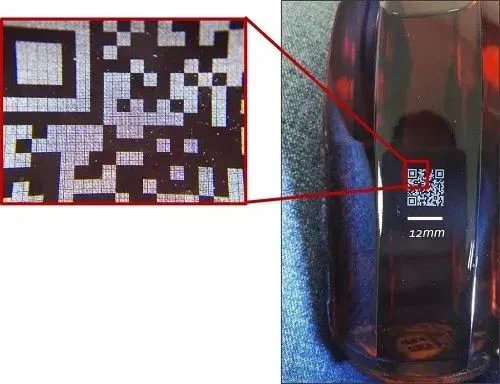
Sequential marking is affected because laser marking must change for each product, so having a marking technology that can be adapted to each product is critical. Manufacturers require extremely high throughput - the marking must adapt and the marking rate must be high - and this doesn't even take into account the difficulties of processing certain materials such as glass or polymers.
To solve this problem, a laser marking solutions manufacturer has patented its VULQ1 technology, which won the Laser Systems Innovation Award at this year's Laser World Photonics Industrial Production Engineering, which does not opt for the use of one continuous beam of light (as is the case with conventional marking systems). Instead, it uses hundreds of light beams to produce a stamp-like effect - producing an entire data matrix code in an instant. The method used to produce this unique stamp is dynamic beam shaping, which is accomplished using components such as the Spatial Light Modulator (SLM), which can adjust on a per-shot basis to create beams with a unique structure.
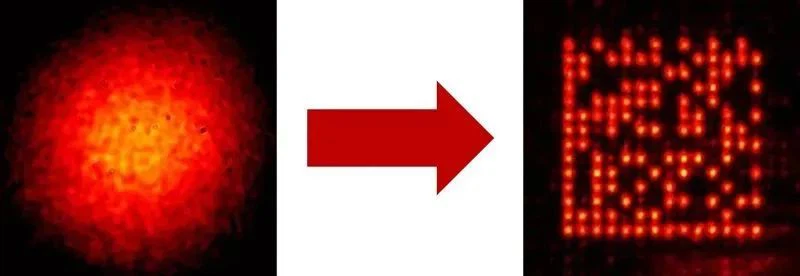
Thibaut says, "This stamp-like marking scheme unlocks tremendous productivity potential for 2D barcode marking and is simple to implement."
For example, its technology can be used to mark PVC medical parts with a 570-μm-wide data matrix code at a rate of 77,000 per hour. Other materials the system can mark include aluminum coated with HDPE polymer; soda-lime glass; borosilicate glass, pure gold, and epoxy molded composite.
Thibault adds, "Pattern sizes can be as small as 100 μm while maintaining perfectly clear readability, even when marking in a straight line, as all dots are marked simultaneously." What's more, because it doesn't have to rely on high repetition frequencies, the technology can build systems using off-the-shelf infrared and green Nd: YAG lasers with repetition frequencies of around 20-30Hz, ensuring that its systems remain as cost-effective as possible.
In 2013, announced its first quartz crystal data storage system, and in 2014, researchers at the University of Southampton's Optoelectronics Research Center (ORC) announced their development of a femtosecond laser-etched glass system. The ORC has begun collaborating with Microsoft Research on "Project Silica" ORC has begun working with Microsoft Research on "Project Silica," which promises to develop zb-scale storage systems and "fundamentally rethink how to build mass storage systems.
Writing on glass is no easy task, however, and standard pulsed UV or CO2 laser systems can create microcracks - excessive heating of the material's surface can lead to damage at thermal hot spots. While this can be circumvented by reducing the pulse energy, it's not ideal when high precision is required. This is why researchers are turning to ultrafast (femtosecond) laser systems to minimize the risk of thermal damage. The ultra-short duration of the high-energy pulse ensures that enough energy is delivered to the material to mark it with extreme precision, creating only minimal heat-affected zones and avoiding microcracks.
The current limitation of this technology is the extremely low speed of data writing, and writing Tb-scale data can take years to complete. Thankfully, ongoing breakthroughs are suggesting ways to increase data writing speeds. Last year, ORC researchers published an energy-efficient laser writing method in the journal Optica: not only is this method fast, but it can store about 500 Tb of data on CD-sized silica discs - they are 10,000 times denser than Blu-ray Disc storage technology.

The researchers' new method uses a 515 nm fiber laser with a repetition frequency of 10 MHz and a pulse duration of 250 fs to create tiny pits in the silica glass, which contain individual nanolaminar structures measuring only 500 × 50 nm. These high-density nanostructures can be used for long-term optical data storage. The researchers achieved a write speed of 1,000,000 voxels per second, which is equivalent to recording about 225 KB of data (more than 100 pages of text) per second.
The new method was used to write 5GB of text data onto a silicon glass disk the size of a conventional CD-ROM with nearly 100% read accuracy. Each voxel contains four bits of information, with every two voxels corresponding to one text character. Using the write density provided by the method, the disc will be able to hold 500 Tb of data. By upgrading the system for parallel writing, it should be feasible to write that much data in about 60 days, the researchers said.


